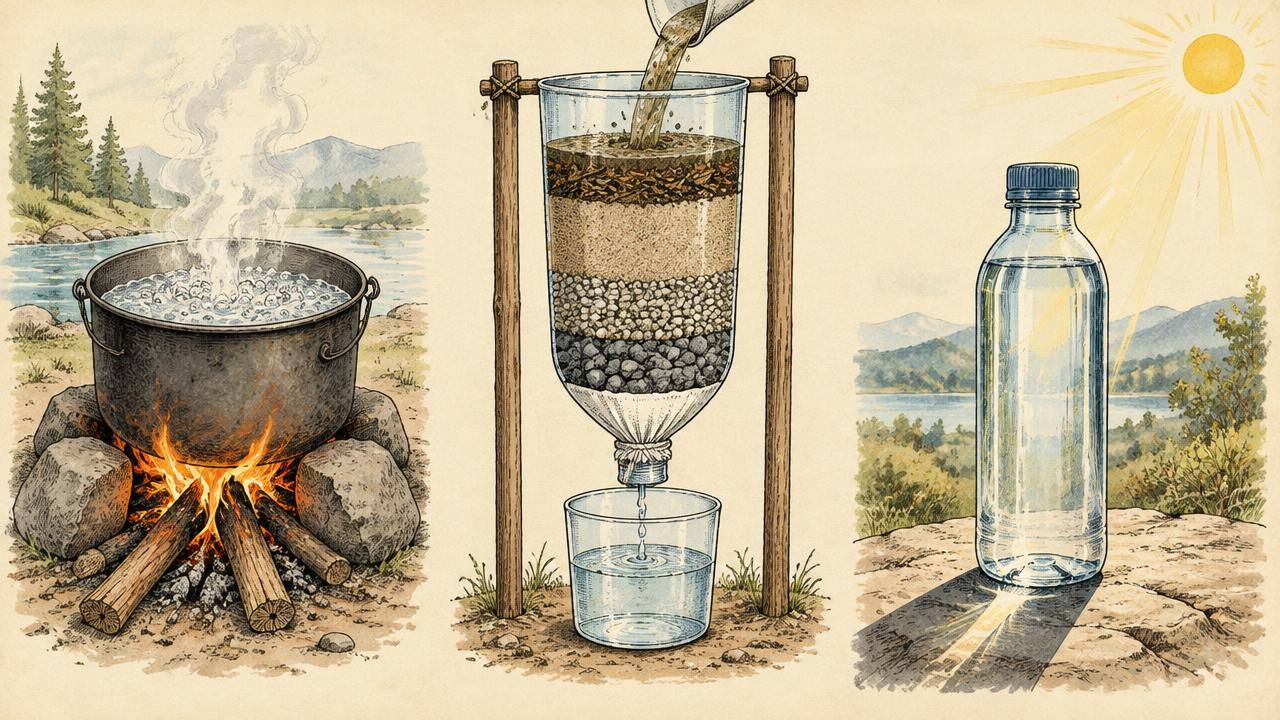
Disinfecting Water by Boiling
The most reliable way to kill disease-causing organisms without chemicals or filters.
Question 1
The goal
Make biologically unsafe water safe to drink.
Question 2
Materials
- Metal pot or kettle
- Heat source
- Clean cloth
- Clean storage container
Question 3
Substitutes
- Metal can (label and liner removed)
- Coffee filter or bandana for clarifying
- Camp stove instead of fire
Where to find it
| Material | Household | Wilderness | Urban / scavenged |
|---|---|---|---|
| Metal pot | Saucepan, kettle | Steel cup or canteen | Clean food can, label removed |
| Heat source | Gas stove (ventilated), grill outdoors | Campfire | Camp stove outdoors |
| Cloth pre-filter | Coffee filter, T-shirt | Bandana | Paper towels |
Question 4
Step by step
- 1
Let cloudy water settle, then pour the clearer top layer through a clean cloth.
- 2
Bring the water to a rolling boil — big bubbles that don't stop when stirred.
- 3
Keep boiling for 1 minute (3 minutes above 6,500 ft / 2,000 m).
- 4
Let it cool naturally with a lid on to avoid recontamination.
- 5
Store in a clean, covered container. Pour between containers to improve flat taste.
Saved steps go to My Survival Notebook.
Question 5
The science
Heat denatures the proteins and nucleic acids of bacteria, viruses and protozoa. Water boils at a lower temperature at altitude, so longer exposure compensates.
Question 6
Dangers & limits
- Boiling does NOT remove chemicals, fuel, heavy metals or salt.
- Burn and scald risk — keep children clear.
- Never boil indoors with a fuel stove without ventilation (carbon monoxide).
Question 7
How you know it worked
A sustained rolling boil was reached and held for the full time; water was cooled and stored covered.