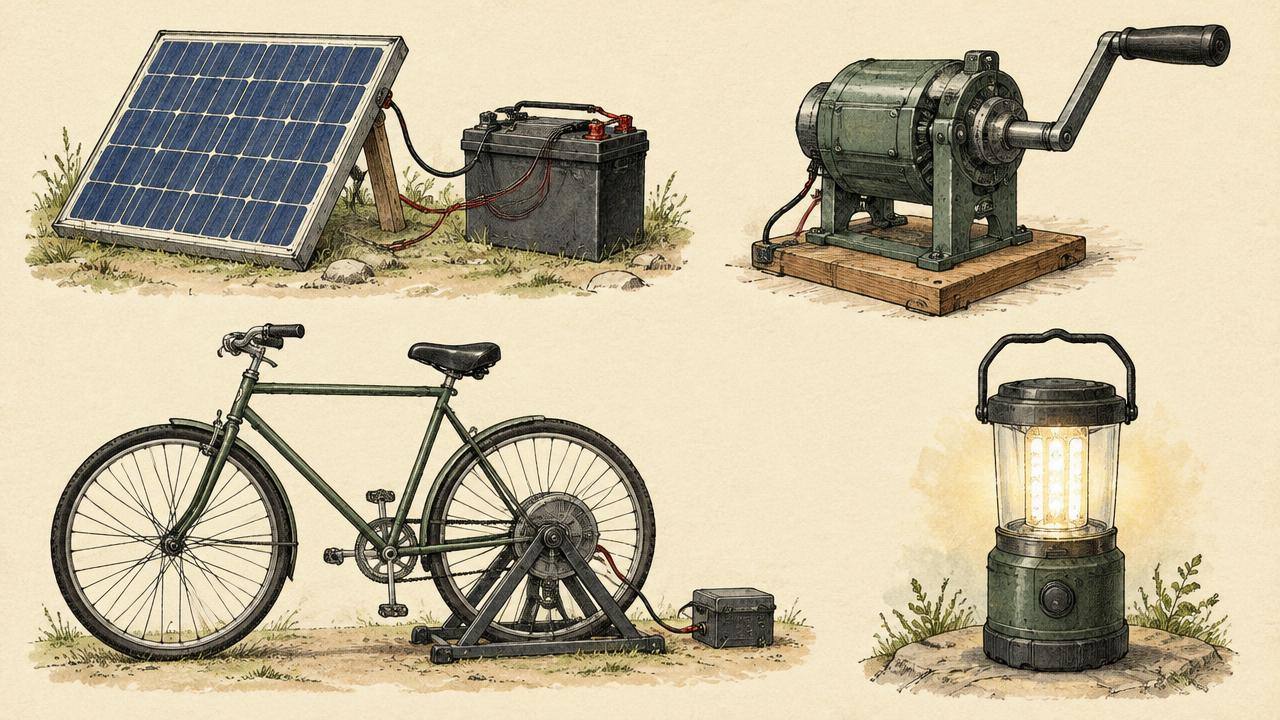
Bicycle Generator
Legs are 3–4× stronger than arms. A bike on a trainer stand can make 50–100 W for a fit adult.
Question 1
The goal
Convert a bicycle into a stationary generator that charges a 12 V battery or power station.
Question 2
Materials
- Bicycle and rear-wheel trainer stand
- Permanent-magnet DC motor (24 V scooter motor or treadmill motor) or purpose-built bike generator kit
- Bracket to press motor shaft against tire (or belt drive)
- Blocking diode (rated 10 A+) or 12 V charge controller
- 12 V battery, fuse, wire
- Voltmeter/ammeter
Question 3
Substitutes
- Commercial pedal generator kit (simplest, safest)
- Hub dynamo + USB converter for phones only (~3 W)
- Rowing machine or treadmill motor rigs
Where to find it
| Material | Household | Wilderness | Urban / scavenged |
|---|---|---|---|
| DC motor | Old treadmill, cordless drill (as generator) | N/A | Scrap yard, scooter repair shop |
| Trainer stand | Exercise gear | Prop rear wheel off the ground with logs | Bike shop, used marketplace |
Question 4
Step by step
- 1
Mount the bike securely on the trainer stand so it can't tip.
- 2
Fix the motor to a sturdy bracket so its shaft (with a rubber roller) presses firmly on the rear tire. Adjust tension so it doesn't slip.
- 3
Wear eye protection and keep loose clothing, hair and children's fingers away from the roller.
- 4
Wire motor + through a blocking diode (or into a charge controller PV input) to a fuse and battery +; motor − to battery −. The diode stops the battery from spinning the motor backwards.
- 5
Add a voltmeter so the rider can see output. Charging needs about 13.5–14.5 V for a 12 V battery.
- 6
Pedal steadily. Start slowly and increase speed until voltage passes battery voltage and current flows.
- 7
Aim for 20–30 minute sessions at a sustainable effort; a fit adult produces 50–100 W for this long, a beginner 30–50 W.
- 8
Expect about 25–50 Wh per 30 minutes — enough to charge 2–4 phones or run an LED light all evening.
- 9
Never exceed about 15 V for a 12 V battery; if you can spin past this, use a charge controller.
- 10
Drink water and take breaks — this is hard exercise.
Saved steps go to My Survival Notebook.
Question 5
The science
The motor works in reverse as a generator. Leg muscles can sustain far more power than arms. Friction rollers lose ~10–20%, so belt drives or commercial kits are more efficient.
Question 6
Dangers & limits
- Pinch and entanglement at the roller.
- Overvoltage can damage batteries — use a controller.
- Overexertion in heat — hydrate and rest.
Question 7
How you know it worked
The meter shows current into the battery while pedaling, and stored energy runs a light or charges a phone afterward.