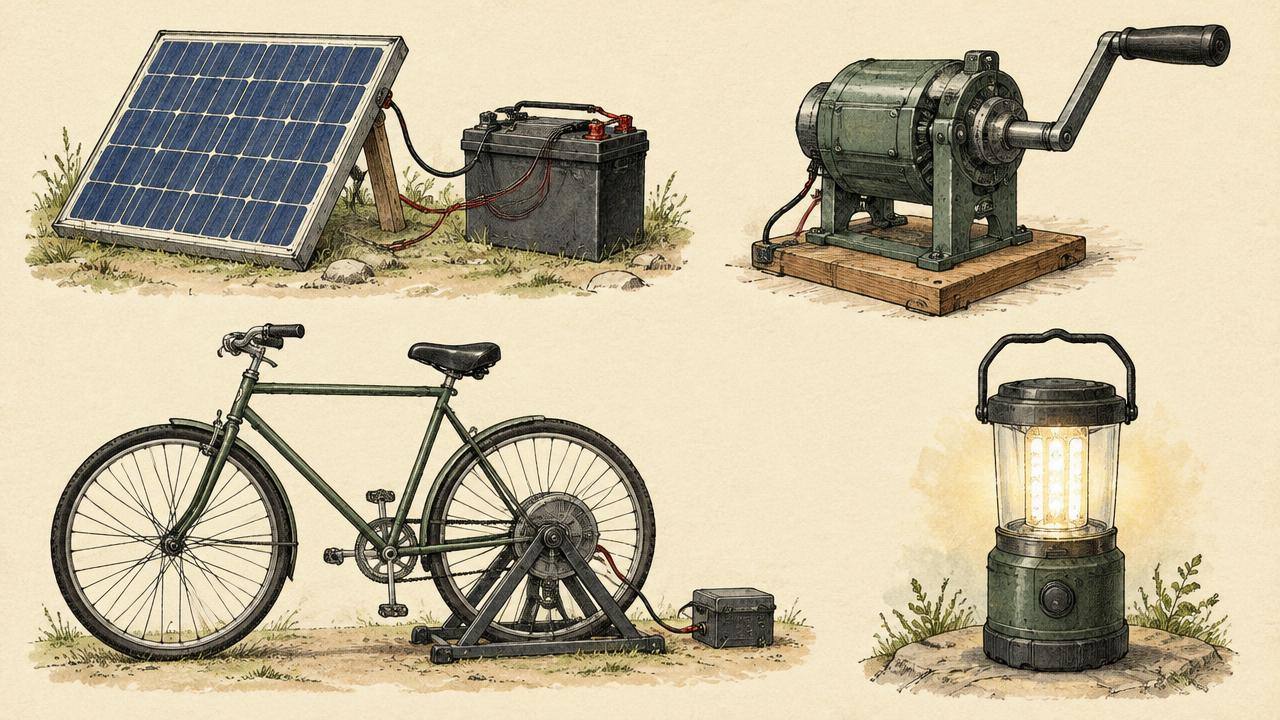
Solar Panel + Charge Controller + Battery System
The most useful long-term off-grid power: a small panel charging a battery that runs lights, phones and a fan for days.
Question 1
The goal
Build a safe 12-volt solar system that produces roughly 300–500 Wh on a sunny day from a 100 W panel.
Question 2
Materials
- 100 W 12 V solar panel
- PWM or MPPT charge controller (10–20 A)
- 12 V deep-cycle battery — LiFePO4 50–100 Ah preferred
- Inline fuses/breakers (one near battery, sized to wire)
- 10–12 AWG wire with MC4 connectors
- 12 V USB socket and/or 300 W pure-sine inverter
- Wrench, wire strippers, crimper, multimeter
Question 3
Substitutes
- All-in-one portable power station with solar input (no wiring)
- Foldable 'solar blanket' panel
- AGM or flooded lead-acid battery (heavier, needs ventilation)
- Car battery in a pinch (shallow use only — it wears out fast)
Where to find it
| Material | Household | Wilderness | Urban / scavenged |
|---|---|---|---|
| Solar panel | Garden light panels (tiny), old RV panel | Folding backpacking panel | Hardware/camping store, used marketplace |
| Battery | UPS battery, power station | Vehicle battery | Golf cart / marine battery shop |
| Wire & fuses | Automotive fuse kit | Vehicle wiring | Auto parts store |
Question 4
Step by step
- 1
Put on safety glasses and remove rings and watches — a shorted battery can weld metal and burn skin.
- 2
Place the battery on a non-flammable surface indoors-but-ventilated (or in a battery box). Lead-acid batteries vent hydrogen while charging; keep them away from flames and sparks.
- 3
Connect the charge controller to the BATTERY FIRST: red wire through a fuse from controller BAT+ to battery +, black from BAT− to battery −. Most controllers need the battery to know the system voltage.
- 4
Check the controller display shows battery voltage (12.0–13.6 V for a healthy 12 V battery).
- 5
Cover the solar panel with a blanket or face it down so it produces no power while you wire it.
- 6
Connect the panel's MC4 leads to the controller PV+ and PV− terminals. Double-check polarity with a multimeter before connecting.
- 7
Uncover the panel and aim it at the sun: face true south (northern hemisphere), tilt roughly equal to your latitude, no shading on any cell — even a shaded corner can cut output by half.
- 8
Confirm the controller shows charging (icon or amps flowing). At midday a 100 W panel typically shows 4–6 A.
- 9
Connect loads to the controller LOAD terminals or a fused 12 V block: USB sockets, 12 V LED strips, 12 V fan.
- 10
For household devices, connect a pure-sine inverter directly to the battery with short, thick cables and its own fuse. Keep inverter loads under 80% of its rating.
- 11
Re-aim the panel 2–3 times a day toward the sun for 20–30% more energy.
- 12
Each evening, check battery voltage. Stop using it around 12.0 V (lead-acid, ~50%) or 12.8 V resting / BMS cutoff (LiFePO4).
Saved steps go to My Survival Notebook.
Question 5
The science
Photovoltaic cells are silicon junctions: photons knock electrons loose and the built-in electric field pushes them through the circuit as direct current. Panels are rated at 1,000 W/m² of sun, so real output is usually 60–80% of the label. The charge controller prevents overcharging, which would boil lead-acid or damage lithium cells.
Question 6
Dangers & limits
- Battery short circuits can cause fire or explosion — always fuse the positive wire within 18 in (45 cm) of the battery.
- Lead-acid batteries contain sulfuric acid and release hydrogen; wear eye protection and gloves and ventilate.
- Never connect a panel directly to a battery without a controller.
- Never wire into home circuits without a transfer switch and licensed electrician — backfeed can kill line workers.
Question 7
How you know it worked
The controller shows charging current in sun, and the battery runs your lights and charges phones overnight without dropping below the safe voltage.