Start Here: Your Blackout Power Budget
Volts, amps, watts and watt-hours in plain English — and how to work out what you actually need before choosing any method.
Question 1
The goal
Calculate how many watt-hours per day your essential devices need so you can pick the right way to make or store electricity.
Question 2
Materials
- Paper and pencil (or phone calculator)
- Device labels / chargers (they list watts or volts × amps)
- Optional: plug-in watt meter (Kill-A-Watt style)
- List of must-have devices
Question 3
Substitutes
- Manufacturer specs online instead of labels
- Rule of thumb: phone 10–15 Wh/charge, LED bulb 5–10 W, CPAP 30–60 W, fridge 100–200 W running
- USB inline meter for small devices
Where to find it
| Material | Household | Wilderness | Urban / scavenged |
|---|---|---|---|
| Watt figures | Device labels, power bricks | Gear manuals | Store shelf specs, maker websites |
| Watt meter | Plug-in meter from hardware store | USB meter | Library tool-lending |
Question 4
Step by step
- 1
Write down every device you truly need in an outage: phones, a radio, LED lights, medical devices (CPAP, oxygen concentrator), fridge, fans, internet router.
- 2
Find each device's power in watts (W) on its label or charger. If it lists volts and amps, multiply them: 5 V × 2 A = 10 W.
- 3
Estimate how many hours per day each device runs. A phone charge is about 2 hours at 5–10 W; LED lights maybe 5 hours.
- 4
Multiply watts × hours for each device to get watt-hours (Wh) per day. Example: 8 W LED × 5 h = 40 Wh.
- 5
Add them up. A typical 'phones, radio, lights, router' kit is 100–200 Wh/day. A refrigerator adds roughly 1,000–2,000 Wh/day.
- 6
Add 25% for losses (inverters, cold batteries, wiring). 160 Wh becomes 200 Wh.
- 7
Note the largest single wattage — this is your 'peak'. Your inverter or power station must handle it; fridges and pumps briefly surge 2–3× when starting.
- 8
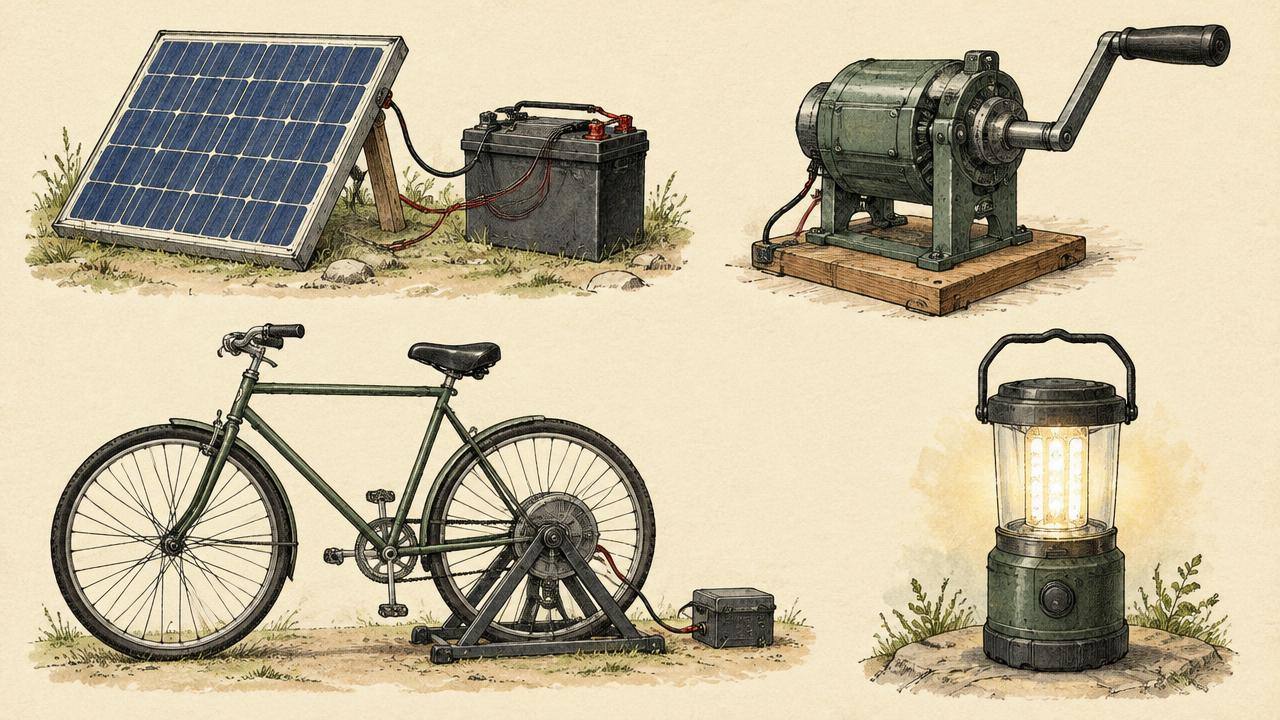
Compare to methods in this discipline: a hand crank gives ~5–20 W while you crank; a 100 W solar panel gives ~300–500 Wh on a sunny day; a car alternator can safely supply ~100–300 W through an inverter.
- 9
Cut the list until it fits what you can realistically generate and store. Swap high-watt items for low-watt ones (LED instead of incandescent, 12 V fan instead of box fan).
- 10
Write the final budget on your family plan and tape it near your battery or power station.
Saved steps go to My Survival Notebook.
Question 5
The science
Power (watts) is the rate of energy use; energy (watt-hours) is power multiplied by time. Batteries are rated in Wh (or amp-hours × volts). Every conversion — DC to AC, charging, heat — loses 10–20% as heat, so real systems always deliver less than the label sum.
Question 6
Dangers & limits
- Never guess medical-device needs — check the manual or ask the supplier; register with your utility's medical priority list.
- Heaters, hair dryers, microwaves and kettles need 1,000–1,800 W and will drain any small system in minutes.
- Don't overload extension cords; check their amp rating.
Question 7
How you know it worked
You have a written daily Wh total and a peak wattage, and you know which methods below can meet it.